
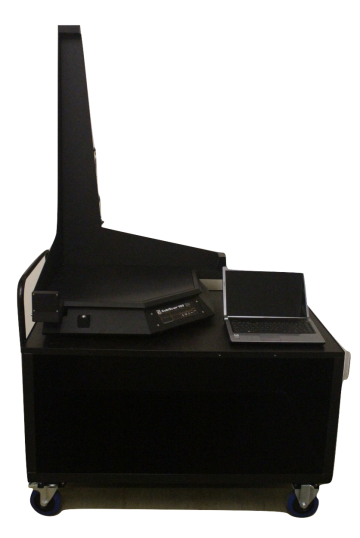
The Cubiscan Mobility system allows the Cubiscan to be taken around the warehouse making data capture a one man process speeding up the data collection time saving resource and money. Comes with battery, inverter, charger, 4 way socket strip and cables and allows for 8 hours continuous operation
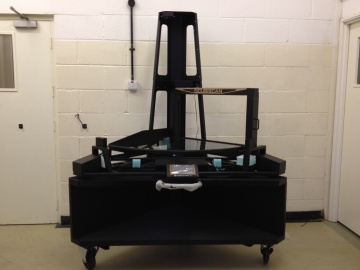
The Cubiscan 125 Mobility system brings the operator to the front of the machine allowing easy operation of the Infrared measuring gate. It allows the Cubiscan to be taken around the warehouse making data capture a one man process speeding up the data collection time saving resource and money. Comes with battery, invertor, charger 4 way socket and cables and allows for 8 hours continuous operation
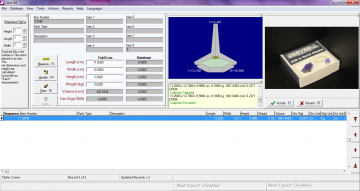
The QbitDB software has an option to capture up to 99 actual product images. This process utilises a Cannon digital SLR camera which gives a very high resolution picture. These pictures are not used for catalogue management but more for internal QC. Some customers display this image to the warehouse pickers on their PDA's
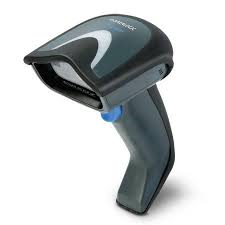
Using a Scan gun connected to the laptop or pc running the QbitDB software speeds up product identification and reduces operator keying errors
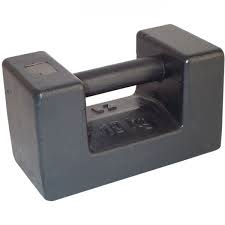
The scale on the Cubiscan is calibrated through the software. To ensure accurate calibration we provide class M1 weights to ensure the scale is working at its optimum
EXDS Limited, 39 Barton Road, Water Eaton Industrial Estate, Milton Keynes, Buckinghamshire, MK2 3HW
Office: +44 (0)1908 648588